- English
- French
- German
- Portuguese
- Spanish
- Russian
- Japanese
- Korean
- Arabic
- Greek
- German
- Turkish
- Italian
- Danish
- Romanian
- Indonesian
- Czech
- Afrikaans
- Swedish
- Polish
- Basque
- Catalan
- Esperanto
- Hindi
- Lao
- Albanian
- Amharic
- Armenian
- Azerbaijani
- Belarusian
- Bengali
- Bosnian
- Bulgarian
- Cebuano
- Chichewa
- Corsican
- Croatian
- Dutch
- Estonian
- Filipino
- Finnish
- Frisian
- Galician
- Georgian
- Gujarati
- Haitian
- Hausa
- Hawaiian
- Hebrew
- Hmong
- Hungarian
- Icelandic
- Igbo
- Javanese
- Kannada
- Kazakh
- Khmer
- Kurdish
- Kyrgyz
- Latin
- Latvian
- Lithuanian
- Luxembou..
- Macedonian
- Malagasy
- Malay
- Malayalam
- Maltese
- Maori
- Marathi
- Mongolian
- Burmese
- Nepali
- Norwegian
- Pashto
- Persian
- Punjabi
- Serbian
- Sesotho
- Sinhala
- Slovak
- Slovenian
- Somali
- Samoan
- Scots Gaelic
- Shona
- Sindhi
- Sundanese
- Swahili
- Tajik
- Tamil
- Telugu
- Thai
- Ukrainian
- Urdu
- Uzbek
- Vietnamese
- Welsh
- Xhosa
- Yiddish
- Yoruba
- Zulu
What Are the Pressure Limits of a Threaded Flange Connection?
To help buyers and project engineers pick the right pipe parts for industrial use, they need to know how much pressure Threaded Flange joints can hold. This type of plate has NPT holes on the inside that are in line with ASME B1.20.1 standards. So, it can connect automatically to lines that have threads on the outside without having to weld them together. It depends on the type of material, the flange class number, the temperature, the amount of thread contact, and how well it was put. If the temperature is room temperature, ASME B16.5 says that Class 150 carbon steel threaded joints can handle up to 285 psi. Class 300 types can handle up to 740 psi. For higher-rated classes, these limits are raised by a lot. The stuff you use is also very important. Steels like ASTM A182 F316 stainless steel can handle acidic situations without getting weak. This directly affects how well the pressure works in the long run and how safe the system is.
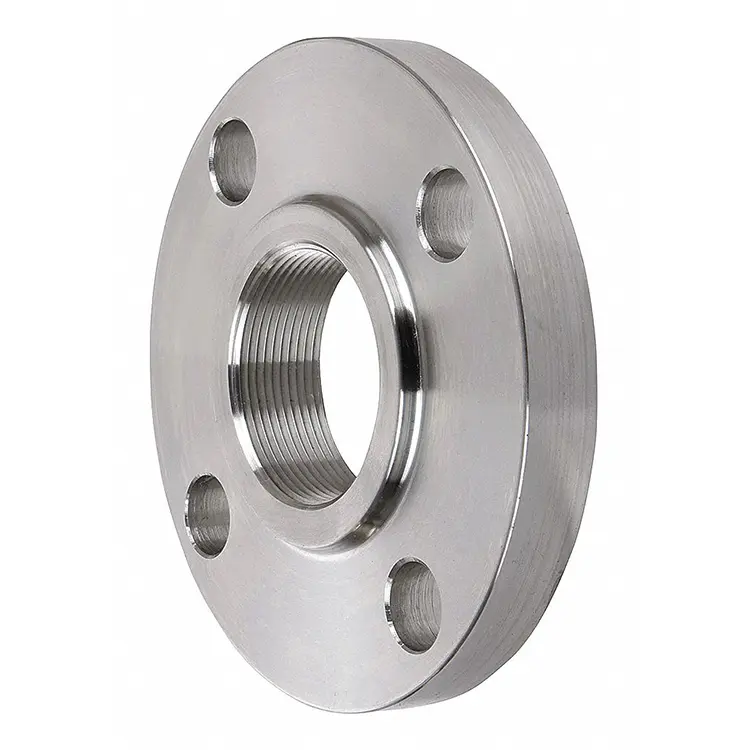
Understanding Threaded Flanges and Their Pressure Limits
Threaded connections are a type of Threaded Flanges that were created to help people in places where welding isn't possible or is too dangerous. In this plan, bent internal threads are used instead of fusion bonding to make a mechanical seal and fit together tightly.
How Thread Design Influences Pressure Capacity?
Each crest and root of an NPT thread is shaped to a 60-degree angle, creating tight metal-to-metal sealing during assembly. Pressure resistance depends on sufficient thread engagement, typically at least three fully engaged threads. Greater contact area improves load distribution and reduces internal stress. Poor thread quality, such as rough or damaged surfaces, creates failure points under cyclic pressure. Precision machining ensures even load sharing across threads, preventing localized overstress. Proper design and manufacturing accuracy are therefore critical to maintaining joint integrity and achieving maximum pressure performance in threaded connections.
Material Strength and Pressure Resistance
Material selection directly determines allowable pressure capacity. Carbon steel ASTM A105 offers high strength and cost efficiency for general applications up to 538°C, while stainless steels like F304 and F316 provide superior corrosion resistance in aggressive environments. Yield strength defines the limit at which deformation occurs under pressure-induced stress. When hoop stress exceeds this limit, permanent damage results. Proper material specification includes safety factors for pressure fluctuations, thermal expansion, and creep. Selecting the right alloy ensures durability, maintains structural integrity, and balances cost with long-term performance in demanding operating conditions.
Environmental Factors Affecting Joint Integrity
Thermal cycling causes expansion and contraction, introducing stress into threaded joints and weakening materials over time. Mismatched thermal expansion rates between components increase strain under temperature changes. Corrosion further reduces thread engagement, especially in chemically aggressive or mixed-metal environments where galvanic effects accelerate degradation. Vibration and cyclic mechanical loads reduce preload, compromising sealing performance. To maintain joint integrity, retention methods such as thread-locking compounds are necessary. Considering environmental factors during design and installation helps preserve pressure capacity and ensures long-term reliability in dynamic industrial conditions.
Pressure Ratings According to Threaded Flange Design Standards
What is the safest amount of pressure and temperature that a pipe part can handle? International standards groups set these numbers for the Threaded Flange class. Teams that buy things can use these models to compare goods from all over the world using the same set of criteria.
ASME B16.5 Pressure Class System
ASME B16.5 defines pressure classes including 150, 300, 400, 600, 900, 1500, and 2500, indicating allowable pressure at specific temperatures. For example, Class 150 carbon steel flanges handle about 285 psi at 38°C but less at higher temperatures due to reduced material strength. Higher classes like 300 and 600 support significantly greater pressures. Threaded connections are typically limited to smaller sizes, usually NPS 2 inches and below, because sealing and assembly become more difficult at larger diameters. These classifications provide a standardized framework for safe design and selection.
European EN 1092-1 and Pressure Nomenclature
European standards use PN ratings, expressed in bar, ranging from PN6 to PN160 for various pressure applications. EN 1092-1 covers threaded flange sizes from DN10 to DN100, aligning roughly with NPS 3/8" to 4". When sourcing internationally, careful comparison between EN and ASTM specifications ensures compatibility. Documentation verifying material origin, grading, and compliance is essential for quality assurance. Pressure testing and third-party inspection reports confirm that components meet required standards. Understanding regional nomenclature helps procurement teams avoid specification errors and ensures reliable integration into global piping systems.
Testing Protocols and Quality Assurance
Flanges are typically tested at 1.5 times their rated working pressure to confirm structural integrity. These tests identify manufacturing defects, material inconsistencies, and dimensional issues before field use. Test durations vary based on component size and standards. Pneumatic testing uses gas instead of liquid but is limited to lower pressures for safety. Certified products include documentation such as material test reports, dimensional inspections, and pressure test results. These records validate quality control processes and provide traceability, ensuring that components meet performance expectations and regulatory requirements.
Comparing Threaded Flange Pressure Limits with Other Flange Types
Pressure capacity is just one of many things that go into the choice of a Threaded Flange. Each flange connection method has its own pros and cons that depend on the application.
Threaded vs. Weld Neck Performance
Threaded versions of the same class can't handle pressures as high as weld neck flanges can. This is because threaded connections concentrate stress in one place, but weld neck designs spread it out more evenly. Class 2500 weld neck flanges can handle pressures over 6000 psi, but threaded designs can't. The heat-affected zone that forms during welding can weaken the material if you don't keep an eye on it. Threaded connections, on the other hand, don't change the properties of the base material through the joint. This is especially helpful when connecting pipes that have protective coatings that welding would destroy.
Slip-On Flanges and Moderate Pressure Applications
It takes two fillet welds, one inside and one outside, to finish the joint with a slip-on flange. Their pressure ratings are in the middle of those of threaded and weld neck equivalents. To put them together, you need welding gear and a hot work permit, which takes away the main benefit that threaded connections have in dangerous places. If you compare slip-on designs to threaded ones, installation becomes harder because of welding. With welding, you have to deal with things like welder qualification, procedure specifications, and post-weld inspection requirements that you don't have to deal with at all with threaded connections. Project schedules benefit from the easier installation that threaded versions allow.
Installation Speed and Maintenance Accessibility
It takes 40–60% less time to install threaded connections than welded ones. Standard wrenches can be used to take apart threaded joints without having to cut or grind, which lets maintenance teams remove equipment without damaging it. This is very helpful in pilot plants, temporary process lines, and systems that need to be reconfigured often. It's better to use threaded designs for blind flanges that are only used temporarily or at growing points in the future that will need to be handled a lot. Being able to take connections off and put them back on without damaging any parts lowers long-term maintenance costs and system downtime.
Installation Best Practices to Ensure Maximum Pressure Capacity
If you use the right fitting methods, Threaded Flange connections will last as long as they say they will. If you use methods that damage the joints, even the best parts will break before they should.
Thread Preparation and Inspection
Before putting the pieces together, make sure the threads are clean so that there are no manufacturing oils, dirt, or corrosion products that could be blocking the metal-to-metal contact. Look at the thread form to make sure it is whole; look for damage, cross-threading, or too much wear that could affect the quality of engagement. Thread gauges check the threads' sizes to make sure they are within the tolerances. You should follow the directions on the package to use either PTFE tape or anaerobic thread sealant. PTFE tape needs to be wrapped three to five times around the thread so that it doesn't come off during assembly. Anaerobic sealants fill in small gaps and make the seal stronger after assembly, but you shouldn't use both at the same time because it depends on the size of the gap.
Torque Application and Tightening Sequence
Not tight enough doesn't seal well enough, and too tight of a fit can damage or gall the threads. Torque specifications take thread size, material, and lubrication conditions into account. Usually, you tighten to finger-tightness and then add more turns based on pipe size, about 2-3 turns for NPS 1/2" and 4-5 turns for NPS 2". You can precisely control the tightening force with a torque wrench if you know what the application calls for it. Gradual, uniform tightening stops cocking or misalignment, which causes uneven stress distribution. For multiple-bolt flange assemblies, star-pattern tightening sequences are needed to keep the parallel flange faces and even gasket compression.
Inspection and Preventive Maintenance
If you do regular visual checks on the joint, you can find early signs of damage before it breaks completely. Look for seepage stains, corrosion products, or mechanical damage that shows the joint's integrity has been compromised. Thermal imaging can find differences in temperature that show interior leaks or flow limits. To fix loose joints caused by thermal cycling, vibration, or gasket creep, you should check the tightness of the joints on a regular basis. This is especially important in the first few weeks after installation, when things start to settle down. Systems that keep track of installation dates, torque values, and inspection results can use trend analysis to find joints that need to be fixed.
Procurement Considerations for Threaded Flanges in High-Pressure Applications
If you want to achieve Threaded Flange procurement excellence, you need to look at more than just the original unit price. The right source affects the quality of the product, the dependability of delivery, and the total cost of ownership over the life of the project.
Certification Verification and Supplier Qualification
Reliable manufacturers will give you material test reports (MTRs) that list the chemical make-up and mechanical properties of each production heat. These certificates prove that materials were tracked from the steel mill to the final machine, which is what quality systems need. ISO 9001 certification proves that suppliers have documented quality management systems, but making great products takes more than just following the steps. Inspection services from a third party make sure that the measurements, material grades, and pressure ratings are correct. For important applications, you may want to require witnessed testing, where your representatives watch the pressure tests and look over the paperwork before approving shipment. This investment prevents costly failures in the field and project delays.
Material Selection Impact on Performance and Cost
You can get the most for your money with carbon steel ASTM A105 for general service uses that won't rust. Stainless steel grades, on the other hand, are 3–4 times more expensive but won't rust in chemical processing and marine environments. A project-specific cost–benefit analysis weighs the higher initial material costs against longer service life and lower maintenance costs. Standard materials don't always work for certain uses. For instance, chrome-molybdenum alloys might need to be strong above 540°C, while materials for cryogenic service might need to be bendable at -46°C and below. Specialized grades increase lead times and unit costs, so it's important to set specifications early on to keep schedules on track.
Bulk Ordering and Lead Time Management
When you buy in bulk, you can take advantage of economies of scale to get lower prices per unit and make sure that you always have inventory for phased construction projects. Manufacturers like HONG KAI FORGING offer competitive pricing structures for bulk orders and can make items from DN15 to DN5000 dimensions. It's easier to keep buying from the same qualified suppliers. It can take anywhere from 2 to 4 weeks to ship standard carbon steel threaded connections in common sizes. However, it could take 8 to 12 weeks for large sizes or exotic alloys. Rush orders cost more, but they give you options when unexpected changes happen to your project schedules.
Conclusion
When it comes to Threaded Flange connections, they can handle different amounts of pressure depending on the class rating, the grade of the material, the quality of the threads, how they are installed, and how they are used. The ASME B16.5 and EN 1092-1 standards are reliable ways to specify the right pressure ratings, which usually range from 285 psi for Class 150 to several thousand psi for higher classes. To make sure a joint lasts a long time, you should choose the right material, do it right, and give it regular maintenance. Knowing these things helps procurement professionals choose threaded connections that meet operational needs, are cost-effective, and can handle the pressure. Working with qualified manufacturers also helps projects succeed by providing technical support and reliable delivery.
FAQ
1. What is the maximum pressure a standard threaded flange can handle?
The ASME B16.5 standard says that Class 150 carbon steel Threaded Flange connections can handle up to 285 psi at room temperature. Class 300 versions can handle up to 740 psi, and Class 600 versions can handle up to 1480 psi. However, these limits drop as the temperature rises because the material becomes less strong. Size also matters—threads with a smaller diameter can handle higher pressures than threads with a larger diameter in the same class because there is less direct force on the threads.
2. Can threaded connections work in high-temperature environments?
To give you an example, carbon steel ASTM A105 can work up to 538°C, but as the temperature rises, so does its pressure rating. Stainless steel grades, on the other hand, can handle higher temperatures and still not rust. Thermal cycling causes expansion stress that can loosen threads over time, so they need to be retorqued regularly. For extreme temperature applications, welded alternatives may be better because they work better at high temperatures.
3. How does material choice affect pressure performance?
If you choose the right material for the job and the service conditions, you can make sure that the system stays safe and that the pressure doesn't change over time. For example, stainless steel F316 is stronger than F304 and can handle higher pressures in corrosive environments. Alloy steels are stronger at high temperatures than carbon steel. Corrosion lowers wall thickness and thread engagement over time, which lowers pressure capacity.
Partner with HONG KAI FORGING for Reliable Threaded Flange Solutions
HONG KAI FORGING manufactures precision-engineered screwed flanges meeting ASME B16.5, EN 1092-1, DIN, and JIS B2220 standards for demanding industrial applications. Located in Dingxiang County—China's forging heartland—our integrated production facilities combine forging, heat treatment, precision machining, and comprehensive testing under one roof. We supply carbon steel, stainless steel, and alloy steel connections from DN15 through DN5000 in pressure classes ranging from PN6 to Class 2500. Our material traceability systems and hydrostatic testing protocols ensure every component meets certified specifications before shipment. As an established Threaded Flange supplier serving energy, petrochemical, water treatment, and heavy industrial sectors across North America and Europe, we understand the critical importance of quality, documentation, and on-time delivery. Contact kevin.zhao@hkflange.com today to discuss your project requirements, request material certifications, or obtain quotations for bulk procurement. Our technical team provides application-specific recommendations optimizing performance, compliance, and cost efficiency for your infrastructure investments.
References
American Society of Mechanical Engineers (2021). "ASME B16.5: Pipe Flanges and Flanged Fittings NPS 1/2 through NPS 24 Metric/Inch Standard." New York: ASME International.
1. European Committee for Standardization (2018). "EN 1092-1: Flanges and Their Joints - Circular Flanges for Pipes, Valves, Fittings and Accessories, PN Designated - Part 1: Steel Flanges." Brussels: CEN.
2. Nayyar, Mohinder L. (2019). "Piping Handbook, Eighth Edition." New York: McGraw-Hill Education Professional.
3. Smith, Peter R. and Zappe, R.W. (2020). "Valve Selection Handbook: Engineering Fundamentals for Selecting the Right Valve Design for Every Industrial Flow Application, Sixth Edition." Oxford: Gulf Professional Publishing.
4. American Petroleum Institute (2020). "API Standard 6A: Wellhead and Christmas Tree Equipment, Twenty-First Edition." Washington: API Publishing Services.
5. Becht, Charles IV (2017). "Process Piping: The Complete Guide to ASME B31.3, Fourth Edition." New York: ASME Press.
Clear Communication, and Reliable Technical Support