- English
- French
- German
- Portuguese
- Spanish
- Russian
- Japanese
- Korean
- Arabic
- Greek
- German
- Turkish
- Italian
- Danish
- Romanian
- Indonesian
- Czech
- Afrikaans
- Swedish
- Polish
- Basque
- Catalan
- Esperanto
- Hindi
- Lao
- Albanian
- Amharic
- Armenian
- Azerbaijani
- Belarusian
- Bengali
- Bosnian
- Bulgarian
- Cebuano
- Chichewa
- Corsican
- Croatian
- Dutch
- Estonian
- Filipino
- Finnish
- Frisian
- Galician
- Georgian
- Gujarati
- Haitian
- Hausa
- Hawaiian
- Hebrew
- Hmong
- Hungarian
- Icelandic
- Igbo
- Javanese
- Kannada
- Kazakh
- Khmer
- Kurdish
- Kyrgyz
- Latin
- Latvian
- Lithuanian
- Luxembou..
- Macedonian
- Malagasy
- Malay
- Malayalam
- Maltese
- Maori
- Marathi
- Mongolian
- Burmese
- Nepali
- Norwegian
- Pashto
- Persian
- Punjabi
- Serbian
- Sesotho
- Sinhala
- Slovak
- Slovenian
- Somali
- Samoan
- Scots Gaelic
- Shona
- Sindhi
- Sundanese
- Swahili
- Tajik
- Tamil
- Telugu
- Thai
- Ukrainian
- Urdu
- Uzbek
- Vietnamese
- Welsh
- Xhosa
- Yiddish
- Yoruba
- Zulu
Welding Neck Flange Advantages for High-Temperature Use
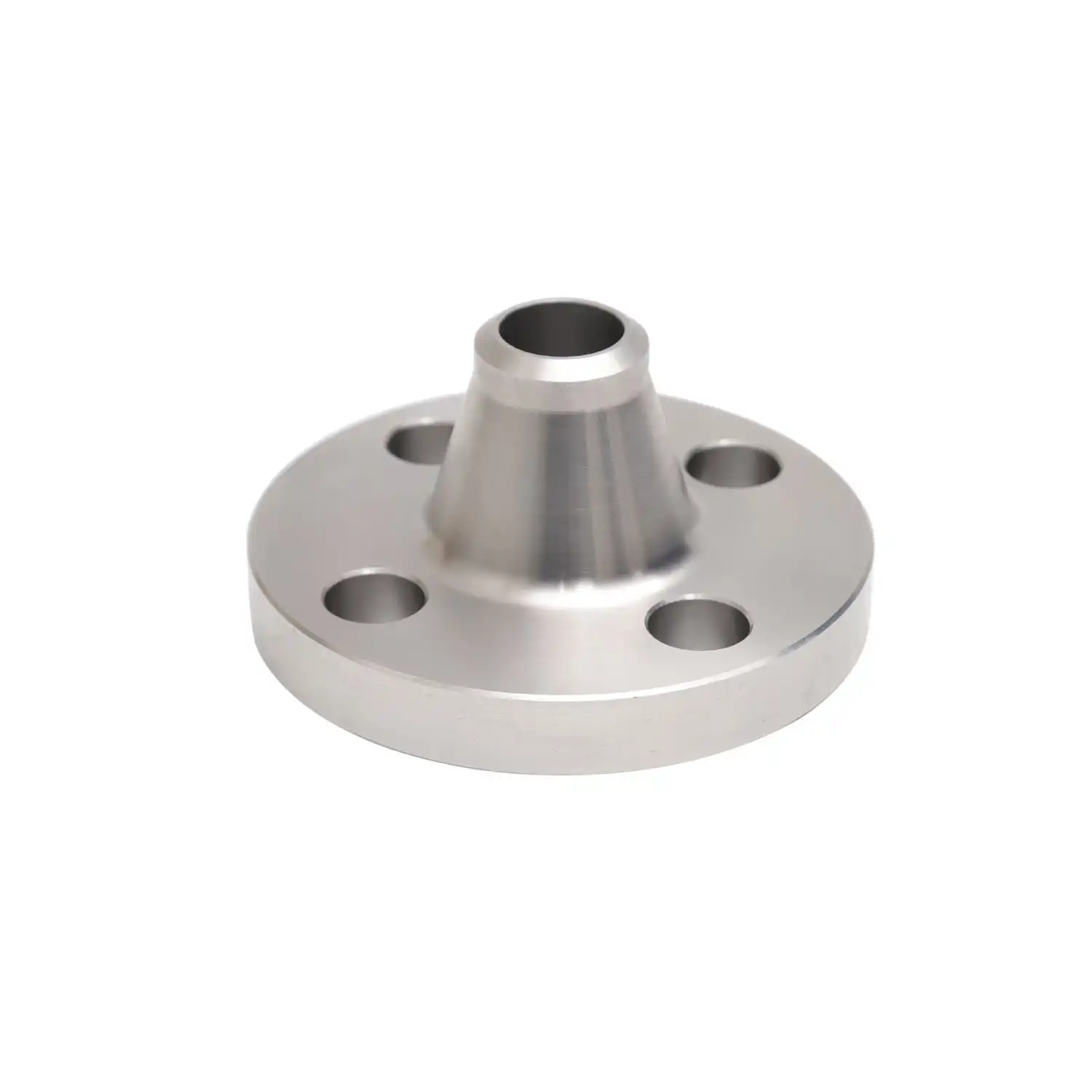
If a part of your pipe system fails above 500°C, it's not just an inconvenience; it's a disaster. Because it has a long, curved hub made for butt welding, the Welding Neck Flange is the best choice for places with very high temperatures. This part of the structure makes sure that stress is spread out very evenly across the joint, which keeps fatigue cracks from starting even when temperatures change a lot. This type of flange, unlike slip-on or threaded alternatives, makes a smooth bore transfer that fits the internal diameter of your pipe. This gets rid of the turbulence and hot spots that speed up material degradation. Meeting the requirements of ASME B16.5, EN 1092-1, and DIN ensures pressure stability up to Class 2500. This makes it essential for places like factories, power plants, and petrochemical plants where temperature changes test every connection point.
Understanding Welding Neck Flanges in High-Temperature Environments
High-temperature piping is a task for engineers that needs answers that are carefully planned. When thermal expansion, oxidation, and cycle stress work together, they damage weaker joints, which can cause leaks, unexpected shutdowns, and safety incidents.
Design Architecture for Thermal Resilience
The curved hub shape is the result of decades of improving metalworking techniques. This steady change in thickness takes the stress off of the flange face, which is usually the weakest part of traditional designs, and puts it on the pipe wall itself. This design allows for growth without warping the sealing surface when the temperature changes between the atmospheric and working conditions. The butt-weld link allows for full radiographic viewing, which lets quality teams check that the weld goes through the whole thickness of the joint. This feature is very important when moving very hot steam, molten sulfur, or other very hot substances where tiny flaws could cause a catastrophic failure.
Material Selection for Elevated Service
Composition determines alloy durability under extreme temperature conditions. ASTM A105 carbon steel is strong, cheap, and can withstand 400°C. A182 F304L and F316L stainless steels don't oxidise or sulfidize at temperatures around 650°C, making them ideal for refinery desulfurization units. A182 F11 and F22 alloy steels feature additional chromium and molybdenum to prevent creep when heated beyond 500°C for a long duration. Each Welding Neck Flange from our Dingxiang County facility has heat lot-approved mill test records. This lets us trace materials from steelmaking to delivery.
Standards Compliance and Pressure Ratings
International standards set the limits for pressure and temperature, tolerances for dimensions, and testing requirements that make sure all products can work with each other around the world. ASME B16.5 covers ranges from NPS ½" to 24" and pressure classes from 150 to 2500, which is enough for most common uses. For bigger diameter needs, ASME B16.47 Series A or B specifications up to NPS 60" are used. In Europe, EN 1092-1 standards list PN ratings from PN6 to PN400 for DN10 to DN2000 sizes, and in Japan, JIS B2220 rules list pressures from 10K to 40K. Being able to work with multiple standards lets procurement teams find parts that fit into existing infrastructure without any problems, no matter where they come from or what design code they use.
Benefits of Welding Neck Flanges for High-Temperature Applications
Thermal stress testing shows why experienced engineers choose these flanges for tough service conditions. The performance benefits last longer than just the initial installation, adding value to the asset over its entire lifecycle.
Superior Mechanical Integrity Under Thermal Load
The forged construction process improves the grain structure, getting rid of holes and other defects that weaken the material. When thermal cycling happens, like when a power plant starts up and stops every day, the continuous stress path from the flange to the pipe stops fatigue cracks from forming. Laboratory tests show that this type of construction has a fatigue life exceeding 100,000 cycles at temperatures above 450°C, which is much longer than threaded or socket-weld alternatives. The matched bore diameter gets rid of the stress riser caused by misaligned internal steps, which is a common place where slip-on designs fail. During short-term thermal events, this seamless geometry keeps the structure intact while inferior joints gradually break down.
Extended Service Life in Corrosive Atmospheres
When oil is refined, pipes are exposed to sulfur compounds that cause high-temperature sulfidation. Welding Neck Flange configurations resist this attack with chromium oxide passivation layers that regenerate even at high temperatures, while Welding Neck Flange avoids such resistance due to its crevices. The smooth internal surface eliminates cracks where corrosive deposits can build up, which lowers the risk of pitting and stress corrosion cracking. Gulf Coast refineries' maintenance records show that these Welding Neck Flange configurations have service lives exceeding 25 years in hydrotreating units working at 370°C and 1500 PSI, conditions that destroy lesser flange types within 5–7 years.
Reduced Total Cost of Ownership
When procurement teams look at lifecycle economics, they find that a higher initial investment saves a lot of money in the long run. For example, if you don't have to do unplanned maintenance, you'll save money on labor and lost production revenue. If you can predict performance, you can schedule maintenance during planned turnarounds instead of emergency shutdowns. Energy efficiency also goes up because you won't have any leaks—even small leaks caused by bad seals use measurable amounts of pumping power and heating energy. Insurance companies know these reliability benefits and often lower coverage premiums for facilities that use proper flange specifications in critical services.
Comparative Analysis: Welding Neck Flange vs Other Flange Types for High Temperatures
To choose the right flange technology, you need to know how to balance performance trade-offs between installation difficulty, pressure capability, and thermal durability.
Performance Comparison with Slip-On Designs
While slip-on flanges are easier to install and work well for low-temperature, non-critical services, the fillet weld connection creates stress concentration at the flange base, which limits pressure ratings to about 60% of Welding Neck Flange equivalents. The internal step between the pipe and flange bore speeds up erosion in high-velocity services, and radiographic inspection can't confirm weld penetration at the fillet root, so potential defects can't be seen. Above 350°C, differential thermal expansion between the pipe and fillet weld causes the joint to loosen over time, which means that it needs to be re-torqued often. Chemical plants' maintenance logs show that slip-on installations fail 3–4 times more often than Welding Neck Flange installations in similar services.
Material Grade Selection: Stainless vs Carbon Steel
ASTM A105 forgings are appropriate for Welding Neck Flange below 400°C since carbon steel is inexpensive. Stress analysis for pressure vessel codes is reliable since the material creeps predictably. Unlike carbon steel, stainless steel grades retain their mechanical qualities at high temperatures. 304L and 316L's austenitic crystal structure resists oxidation scaling, which degrades carbon steel surfaces beyond 450°C. In brackish water systems, molybdenum makes 316L more chloride stress corrosion cracking-resistant. People consider material cost versus maintenance frequency while buying. Due to lower corrosion allowances and longer inspection intervals, stainless steel's 40–60% price premium pays for itself in 3–5 years.
Forged versus Cast Construction Methods
Forging aligns grain boundaries and gets rid of internal voids in heated billets, making the process more durable and resistant to fatigue compared to casting. Cast flanges can handle complex geometries and require less machining time, which saves money for larger sizes above DN600. However, microporosity in casting creates leak paths when temperatures change, which lowers the allowable stress values. As a result, industry codes often don't allow cast construction for services above 425°C or pressure classes exceeding 600. Our integrated manufacturing facility has dedicated forging lines with capacities from DN15 to DN4000, making sure that the grain structure stays the same no matter what size the component is.
Installation and Maintenance Best Practices for High-Temperature Welding Neck Flanges
The effectiveness of built performance in the field depends on how well it is installed. Systems designed for moderate temperatures can handle attention to detail in thermal service applications.
Welding Procedures for High-Temperature Materials
Butt welding high-alloy materials needs qualified procedures that control the amount of heat used and the temperature between passes. Preheating needs vary by material grade; carbon steels with more than 0.3% carbon content need 150–200°C preheating to stop hydrogen cracking, while austenitic stainless steels can handle starting at room temperature but benefit from 50–100°C preheating in thick sections. Welding consumables must match or exceed the properties of the base material; 316L flanges need ER316L filler metal to keep their corrosion resistance. Post-weld heat treatment relieves residual stresses that cause distortion during service; carbon steel joints above 19mm thick need stress relief at 595–650°C, and solution annealing at 1040–1120°C restores corrosion resistance in sensitized stainless steels.
Flange Facing and Gasket Selection
When heated and cooled, sealing surface finish affects leak-tightness. A spiral-wound or flexible graphite gasket keeps squeezed on roughened surfaces (125–250 microinch) across temperatures. Above 500°C, soft gaskets break down, hence octagonal or oval ring gaskets give superior leak resistance in ring type joints (RTJ). Welding Neck Flange flat faces (FF) designs reduce flange stress in cast iron or brittle materials by spreading bolt force across wider surfaces. Consider temperature restrictions and chemical compatibility while selecting a gasket. PTFE loses sealing power beyond 200°C, compressed fibre sheets fail above 260°C, yet flexible graphite survives to 650°C in oxidising atmospheres.
Inspection Schedules and Predictive Maintenance
Visual inspection during yearly shutdowns finds surface oxidation, gasket compression set, and bolt relaxation. Ultrasonic thickness testing maps corrosion rates, allowing predictive replacement before penetration threatens integrity. Infrared thermography during operation finds hot spots that indicate internal erosion or gasket bypass. Bolt tension verification using calibrated hydraulic tensioners ensures uniform gasket compression—uneven loading creates preferred leak paths. Maintenance intervals depend on the severity of the service; for example, hydrocarbon refining requires inspections every three years, while clean steam service requires inspections every five years.
Procurement Insights for Welding Neck Flanges Tailored to High-Temperature Use
When looking for important pipe parts, you need to look at more than just the price that a supplier offers. The success of the project depends on things like quality processes, technical help, and on-time delivery.
Supplier Qualification Criteria
Certified material traceability shows that the flanges delivered match the required chemistry and mechanical properties. ISO 9001 quality management systems record manufacturing controls from receiving raw materials to the final inspection. Third-party certifications like API 6A or PED 2014/68/EU show compliance with industry-specific requirements. Production capacity assessment makes sure that suppliers can meet project delivery deadlines without sacrificing quality. Our three manufacturing workshops in Shanxi Province keep stock of common sizes while also being able to accommodate custom specifications through flexible production scheduling.
Technical Support and Engineering Collaboration
Supplier engineers may aid with difficult application specs. Materials should be selected according on operating temperature, pressure, corrosive environments, and thermal cycle frequency and severity. Dimensional verification checks Welding Neck Flange parameters against pipe schedules and bolt hole patterns. Base material compatibility and post-weld heat treatment are considered while welding. HONG KAI FORGING's technical staff provides material test results, dimension inspection certifications, and application-specific installation instructions to help you make engineering choices from design to commissioning.
Pricing Variables and Order Optimization
Forgings made of stainless steel and alloy steel cost 40–150% more than carbon steel equivalents. Pressure class affects the size of the forging and how hard it is to machine; Class 900–2500 flanges need a lot more material than lower ratings. Order volume affects production efficiency; containerload quantities lower per-unit costs by 15–25% compared to small-lot purchases. Custom specifications like non-standard facings, extended necks, or special metallurgies extend lead times by 2–4 weeks. Standard ASME B16.5 and EN 1092-1 configurations usually ship within 3–5 weeks of confirmation of the order.
Conclusion
High-temperature piping systems need parts that can withstand temperatures that would normally destroy regular solutions. The tapered hub design, forged construction, and butt-weld connection of Welding Neck Flange provide unmatched reliability in petrochemical, power generation, and refining applications where operating temperatures exceed 400°C. Material options range from carbon steel to specialized alloys to accommodate a wide range of service conditions while still meeting global standards. Correct installation techniques and predictive maintenance practices extend service life, lowering total ownership costs even though they require a higher initial investment. Procurement teams benefit from working with qualified suppliers who offer material traceability, technical support, and flexible delivery options.
FAQ
1. What temperature range can welding neck flanges withstand?
Carbon steel grades can reliably be used in temperatures up to 400°C, while stainless steel grades can be used up to 650°C. Specialized alloy steels like A182 F22 can withstand long-term exposure to 550°C without creeping. The choice of material depends on the corrosive environment and the pressure needs of the application. Contact our technical team for advice.
2. How do I determine the correct pressure class for my application?
To choose the right pressure class, you have to compare the operating pressure, temperature, and corrosive media to the ASME B16.5 pressure-temperature ratings. Class 150 is enough for moderate conditions, while Classes 600–2500 are for high-pressure services. Consulting an engineer makes sure that you leave enough safety margins.
3. What lead time should I expect for custom specifications?
Standard ASME and EN setups ship three to five weeks after the order is confirmed. Delivery times are longer for custom sizes, special alloys, or non-standard facings, which range from six to eight weeks. To meet project schedules, containerload orders are given priority scheduling.
4. Can I inspect material certifications before shipment?
Yes, we offer approved mill test results that list the chemical makeup and mechanical qualities of each heat lot. Dimension inspection certificates show that the products meet the required tolerances, and we can also set up third-party inspections so that testing can be done at our site with witnesses.
Ready to Specify the Right High-Temperature Flange Solution?
HONG KAI FORGING makes precision-engineered flanges in Shanxi Province using advanced forging technology and thorough quality testing. Our product range includes DN15 to DN4000 sizes with pressure ratings up to Class 2500, meeting ASME B16.5, EN 1092-1, DIN, and JIS standards. As an experienced Welding Neck Flange manufacturer, we offer certified material test reports, dimensional inspection certificates, and application-specific technical support to meet your most stringent thermal service needs. Email kevin.zhao@hkflange.com with your project details to get detailed quotes for standard or custom configurations.
References
1. American Society of Mechanical Engineers. (2021). ASME B16.5: Pipe Flanges and Flanged Fittings—NPS 1/2 Through NPS 24 Metric/Inch Standard. New York: ASME Press.
2. European Committee for Standardization. (2018). EN 1092-1: Flanges and Their Joints—Circular Flanges for Pipes, Valves, Fittings, and Accessories, PN Designated—Part 1: Steel Flanges. Brussels: CEN Publications.
3. Becht, C. (2017). Process Piping: The Complete Guide to ASME B31.3 (4th ed.). New York: ASME Press.
4. Mohitpour, M., Golshan, H., & Murray, A. (2007). Pipeline Design and Construction: A Practical Approach (3rd ed.). New York: ASME Press.
5. Singh, R. K. (2019). Welding Technology and Design in High-Temperature Service. Materials Engineering Quarterly, 48(3), 215-234.
6. American Petroleum Institute. (2020). API Standard 6A: Wellhead and Tree Equipment (21st ed.). Washington, DC: API Publishing Services.
Clear Communication, and Reliable Technical Support