- English
- French
- German
- Portuguese
- Spanish
- Russian
- Japanese
- Korean
- Arabic
- Greek
- German
- Turkish
- Italian
- Danish
- Romanian
- Indonesian
- Czech
- Afrikaans
- Swedish
- Polish
- Basque
- Catalan
- Esperanto
- Hindi
- Lao
- Albanian
- Amharic
- Armenian
- Azerbaijani
- Belarusian
- Bengali
- Bosnian
- Bulgarian
- Cebuano
- Chichewa
- Corsican
- Croatian
- Dutch
- Estonian
- Filipino
- Finnish
- Frisian
- Galician
- Georgian
- Gujarati
- Haitian
- Hausa
- Hawaiian
- Hebrew
- Hmong
- Hungarian
- Icelandic
- Igbo
- Javanese
- Kannada
- Kazakh
- Khmer
- Kurdish
- Kyrgyz
- Latin
- Latvian
- Lithuanian
- Luxembou..
- Macedonian
- Malagasy
- Malay
- Malayalam
- Maltese
- Maori
- Marathi
- Mongolian
- Burmese
- Nepali
- Norwegian
- Pashto
- Persian
- Punjabi
- Serbian
- Sesotho
- Sinhala
- Slovak
- Slovenian
- Somali
- Samoan
- Scots Gaelic
- Shona
- Sindhi
- Sundanese
- Swahili
- Tajik
- Tamil
- Telugu
- Thai
- Ukrainian
- Urdu
- Uzbek
- Vietnamese
- Welsh
- Xhosa
- Yiddish
- Yoruba
- Zulu
What Is a Socked Welding Flange and How It Works in Systems?
Socked Welding Flange have a recessed counterbore that accepts the pipe end and creates a strong exterior fillet welding connection. Its internal weld protrusion-free design is appropriate for small-diameter, high-pressure pipes that must avoid flow contamination. Installation requires no tack welding since the socket design aligns naturally, creating permanent, leak-proof couplings for hazardous media transmission in industrial applications.
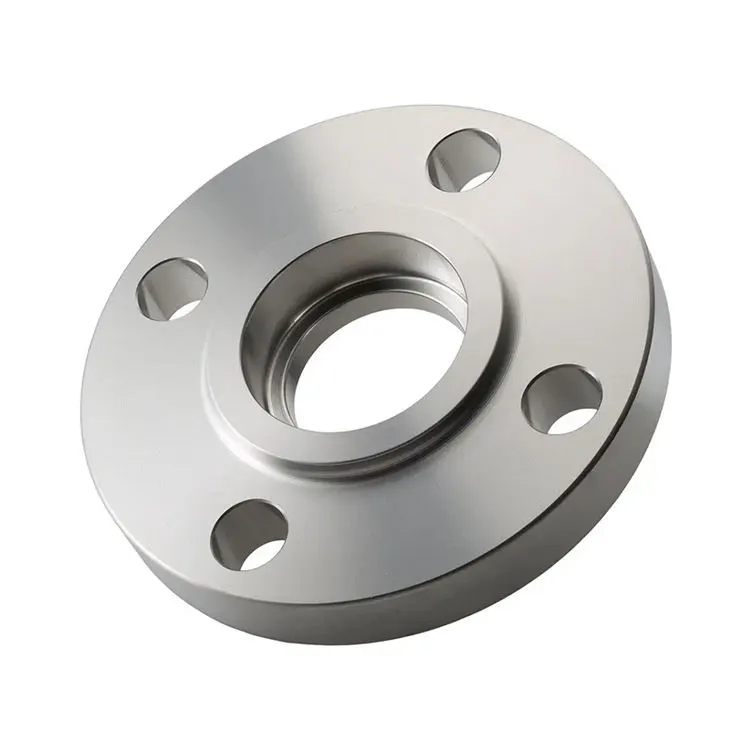
Understanding Socket Welding Flanges: Specifications, Design, and Materials
Technical Design Features and Construction
The counterbore of socket welding flanges allows pipes to go right into the hub before welding. Precise casting and meticulous cutting provide accurate measurements. To satisfy international requirements and perform effectively in harsh situations, each flange undergoes several quality inspections. Per ASME B16.5, an expansion gap of 1/16 inch (1.6 mm) and 125–250 RMS face finish are needed. Carbon steel must have a hardness value of HB ≤ 200. Temperatures vary from -29°C to +400°C depending on material. This allows these parts to be utilised in many commercial contexts.
International Standards and Compliance
To ensure safety and compatibility globally, these flanges fulfil many requirements. ASME B16.5 covers NPS 1/8" to 4" and 150–2500 pressure classes. EN 1092-1 covers DN6–DN100 diameters and PN16–PN400 pressures. Sizes DN6 to DN100 can bear 10K to 40K pounds of pressure, according JIS B2220. Socked Welding Flange is available in alloy steel, carbon steel (ASTM A105), and stainless steel (ASTM A182 F304/316L). They can handle practically any industrial plumbing demand with pressure levels from PN6 to PN160 and sizes from DN15 to DN5000. Request custom goods for your work.
Material Selection and Quality Assurance
Product demands, operational circumstances, and media compatibility determine material choice. Carbon steel is suitable for ordinary industrial applications, whereas stainless steel is better for chemical processing since it resists corrosion. For demanding operations, alloy steel is stronger and temperature-resistant. Quality assurance involves inspecting dimensions, certifying materials, and exerting pressure to ensure long-term reliability. To fulfil criteria, each batch undergoes chemical composition analysis, mechanical property verification, and dimension inspection.
How Socket Welding Flanges Work in Systems and Their Advantages
Installation Process and System Integration
The first step in fitting is to put the pipe into the flange hole and make sure it is lined up correctly and has the right expansion gap. The external fillet weld makes a strong, lasting link and makes it easy to see how good the weld is. This method gets rid of the hassle of internal welding and lowers the chance that the weld will get into the flow stream. System integration has many benefits, such as making fit-up processes easier, cutting down on installation time, and getting rid of welding mistakes. Technicians can quickly get things lined up correctly, even in tough field situations where limited room makes it hard to get to places. The socket design allows for natural placement, which makes fitting easier for people who aren't skilled at butt welding.
Performance Advantages in Industrial Applications
Here are the main reasons why socket welding flanges are better for certain uses in terms of performance:
- Better resistance to fatigue—has 50% higher fatigue strength than regular slip-on designs, which is important for places with a lot of shaking, like hydraulic systems and steam lines, where stress cycles happen all the time.
- Leak-proof integrity: The socket arrangement makes a strong seal that stops fugitive emissions. This is important for media that is dangerous or expensive and needs to have no leaking for safety and cost reasons.
- Efficient installation—The built-in alignment feature of the Socked Welding Flange cuts down on installation time and eliminates welding mistakes, so experts can quickly get the job done right in tight areas.
- Cost-effective performance—Socket welds work just as well as butt weld flanges, but they don't need as much precise cutting and preparation, which lowers the overall cost of the job without lowering the quality.
These benefits successfully fix important production issues like system downtime because of leaks, high maintenance costs because of failures caused by vibrations, and safety risks related to handling dangerous media.
Operational Benefits and System Reliability
Because it is built to last and has a history of working well, the Socket Welding Flange design makes the system very reliable. The external weld design makes checking and upkeep easy, and the socket design makes sure that the pipes are supported and lined up correctly for the whole system's life. The benefits of system reliability include less upkeep, better safety performance, and higher operating efficiency. The fixed connection doesn't need to be retightened as often as threaded connections do, and it's better at withstanding changes in temperature than other small-bore connection methods.
Comparing Socket Welding Flanges with Other Flange Types
Strength and Pressure Handling Comparison
When looking at different ways to connect small-bore pipe systems, Socket Welding Flange fittings are clearly better than others. When compared to slip-on flanges, socket welds have a much higher stress strength while still having the same static strength. The simple overlap joint of slip-on designs doesn't spread stress as well as the fillet weld link. Even though threaded flanges are easy to install, they are not as leak-proof as soldered joints, especially in places where vibrations are common. Butt weld flanges are just as strong as socket welds, but they need to be prepared more precisely and have better access for welding on the inside. This makes them impractical for many small-bore uses where socket welds work better.
Installation and Maintenance Considerations
Different types of Socket Welding Flange have very different levels of difficulty when it comes to installation. Socket welds are the most useful and work the best. Because the socket helps with alignment, it gets rid of the need for complicated fit-up steps that are needed for butt welds and works better than threaded options. Socket welds are better for maintenance than threaded connections because the threads need to be retightened and the seals need to be replaced every so often. The permanent welded link gets rid of these regular upkeep chores and makes it easier to check visually than buried welds in other designs.
Cost-Benefit Analysis for Procurement Teams
When making a purchase, you need to think about the original cost, the difficulty of installing, and the long-term costs of running the business. Most of the time, socket welding flanges cost more than slip-on versions but less than weld neck versions. However, they work better and require less upkeep, so the extra money is well spent. A study of the total cost of ownership shows that socket welds often have the lowest lifetime costs for small-bore uses. This is especially true in high-vibration or critical service settings where the dependability of the connection directly affects the safety and availability of operations.
Procurement Insights: How to Choose, Source, and Buy Socket Welding Flanges
Supplier Evaluation and Quality Verification
To find trusted providers, you need to carefully look at their manufacturing skills, quality systems, and industry qualifications. Check to see if any possible suppliers are still certified to meet important standards like ASME, EN, DIN, JIS, and GOST. Check the quality records, which include pressure test results, material test certificates, and measurement inspection reports. Audits of manufacturing facilities can teach you a lot about how to make things and how to check for quality. Forging, heat treatment, machining, and testing should all be able to be done under one roof. This will usually lead to better quality control and faster wait times.
Technical Specification and Material Selection
Accurate system needs, such as pressure, temperature, media compatibility, and weather conditions, are the first step in developing specifications. Match these needs with the right material grades and pressure classes, keeping in mind that the system or working conditions may change in the future. Complete material tracking, dimensional approval, and pressure test records for Socked Welding Flange should all be required as proof. Include any extra testing needs, like NACE compliance for sour service uses or specific hardness needs for erosive service situations.
Logistics and Supply Chain Considerations
When you do global shopping, you need to pay close attention to arrival times, shipping methods, and packaging needs. Check to see what the seller can do for safe packaging, foreign shipping paperwork, and help with customs clearance. For people who buy a lot, you might want to think about inventory management techniques like exchange agreements or blanket purchase orders. Managing lead times is important for keeping projects on schedule, especially when materials or sizes aren't standard. Set up clear rules for discussion and tracking of milestones to make sure that delivery meets project needs and avoids costly delays.
Maintenance, Inspection, and Troubleshooting of Socket Welding Flanges
Preventive Maintenance Protocols
Setting up the right check times for Socket Welding Flange installations based on service conditions, media properties, and system importance is the first step in making maintenance plans that work. During regular system upkeep, the outside welds should be looked at visually for signs of cracking, rust, or mechanical damage. Protocols for documentation should keep track of the results of inspections, upkeep work, and any problems or fixes that are found. This past data lets us look at trends and make predictions about when maintenance will need to be done. This cuts down on unexpected fails and makes the best use of maintenance resources.
Nondestructive Testing and Quality Verification
Nondestructive testing methods give useful information about the health of a link without affecting the system. Ultrasonic testing is a good way to find problems inside a weld, while an x-ray shows joint depth and possible inclusion issues. Magnetic particle testing finds cracks on the surface and close to the surface of ferromagnetic materials. How often you test Socked Welding Flange depends on how important the service is; critical applications need to be checked more often. Set up standard measures during the initial installation so that you can compare them to inspection results in the future and see patterns of wear and tear before they break.
Common Issues and Troubleshooting Strategies
Weld cracks caused by thermal stress, rust from aggressive media, and mechanical damage from system shaking or thermal expansion are all common flaws. Regular inspections help find problems early so they can be fixed before they get really bad. Repair methods range based on the type and seriousness of the flaw, ranging from fixing a single weld to replacing the whole flange. Create uniform repair steps and skilled welding standards to make sure that the quality of repairs is always the same and that the system works well.
Conclusion
For uses involving small-diameter, high-pressure pipes that need solid, leak-tight connections, Socked Welding Flange are the best choice. Their special design combines the power of welded joints with easier installation. This makes them perfect for use in sensors, hydraulic systems, and process lines where the integrity of the system can't be compromised. The mix of better fatigue resistance, leak-proof performance, and ease of installation makes this link method clearly superior to others. When ordered, fitted, and taken care of correctly, these flanges provide excellent long-term performance in tough industrial settings, helping to meet practical reliability and safety goals in a wide range of situations.
FAQ
1. What are the main differences between socket welding and slip-on flanges?
Socket Welding Flange components feature a recessed bore that provides pipe alignment and support, while slip-on flanges simply slide over the pipe end. Because they are made in a fillet shape, socket welds have 50% higher stress strength and better leak resistance, which makes them better for uses that will be vibrating a lot.
2. Are socket welding flanges suitable for high-pressure applications?
Socket welding flanges work great in high-pressure situations up to Class 2500 grades, especially in systems with small size pipes. Welded connections are better than threaded ones because they are stable and leak-tight, and they are easier to install than butt weld configurations.
3. What delivery timelines can be expected for bulk socket welding flange orders?
Standard material and size combinations typically ship within 2-4 weeks for bulk orders, while custom specifications or exotic materials may require 6-8 weeks. Establishing blanket purchase orders with scheduled releases helps minimize lead times for high-volume users.
Partner with HONG KAI FORGING for Premium Socket Welding Solutions
Industrial procurement teams seeking reliable Socked Welding Flange manufacturers can benefit from HONG KAI FORGING's comprehensive manufacturing capabilities and quality expertise. Our combined facilities are in the industrial center of Shanxi Province. They mix forging, heat treatment, machining, and testing to make sure uniform quality and fast delivery. Our product line includes all the major foreign standards, like ASME, EN, DIN, and JIS. We use a wide range of materials, from carbon steel to special metals for tough jobs. Contact kevin.zhao@hkflange.com to talk about your specific needs and see how our dedication to quality control, customer happiness, and excellent production has won the trust of procurement professionals all over the world.
References
1. American Society of Mechanical Engineers. "ASME B16.5 Pipe Flanges and Flanged Fittings: NPS 1/2 through NPS 24 Metric/Inch Standard." New York: ASME Press, 2020.
2. European Committee for Standardization. "EN 1092-1 Flanges and Their Joints - Circular Flanges for Pipes, Valves, Fittings and Accessories, PN Designated - Part 1: Steel Flanges." Brussels: CEN, 2018.
3. Mohitpour, M., H. Golshan, and A. Murray. "Pipeline Design and Construction: A Practical Approach, Third Edition." New York: American Society of Civil Engineers, 2007.
4. Nayyar, Mohinder L. "Piping Handbook, Seventh Edition." New York: McGraw-Hill Professional, 2000.
5. Singh, Karan P. "Mechanical Engineering Handbook: Piping Systems and Pipeline Engineering." Boca Raton: CRC Press, 2019.
6. Antaki, George A. "Piping and Pipeline Engineering: Design, Construction, Maintenance, Integrity, and Repair." New York: Marcel Dekker, 2003.
Clear Communication, and Reliable Technical Support